The Philosopher of the Abyss: Why Arthur Schopenhauer Terrifies the Modern Algorithm
The Architecture of Intellectual Danger
Imagine, for a moment, the sterile, humming server farms of Silicon Valley—the invisible architecture where the boundaries of modern acceptable discourse are coded, monitored, and enforced. Within these digital panopticons, algorithms are trained to hunt down hate speech, misogyny, and pathogenic ideas that threaten the social fabric. Now, imagine these hyper-modern, sophisticated systems choking on the words of a bitter, solitary German philosopher who died in 1860.
To read Arthur Schopenhauer today—specifically his unvarnished, vitriolic societal critiques—is to handle unexploded ordnance from the nineteenth century.
In an era defined by the sanitization of language and the curation of "safe" intellectual spaces, Schopenhauer stands as an intolerable anomaly. His most transgressive works, particularly his notorious 1851 essay Über die Weiber ("On Women"), alongside his broader, lacerating takes on human nature, democracy, and society, routinely trigger modern platform bans. Post an unfiltered excerpt of Schopenhauer’s views on gender dynamics to a major social media platform today, and you are likely to be met with a swift suspension, a shadowban, or a stern warning regarding community guidelines.
But why do we ban dead philosophers? What does it say about our cultural moment that the musings of a man who wrote by candlelight, long before the advent of the microchip, possess such explosive, disruptive power that they must be quarantined by modern tech conglomerates?
This is not merely a question of historical curiosity; it is a profound inquiry into the nature of censorship, the genealogy of modern thought, and the limits of intellectual freedom. The modern algorithmic reflex to erase Schopenhauer forces us to confront a deeply uncomfortable question: Are we protecting society from dangerous ideas, or are we infantilizing the modern mind, rendering it incapable of grappling with the darkest, most transgressive corners of the human intellect?
The Anatomy of a Misanthrope
To understand the terror Schopenhauer strikes into the heart of the modern censor, one must first understand the man and the metaphysical architecture of his despair.
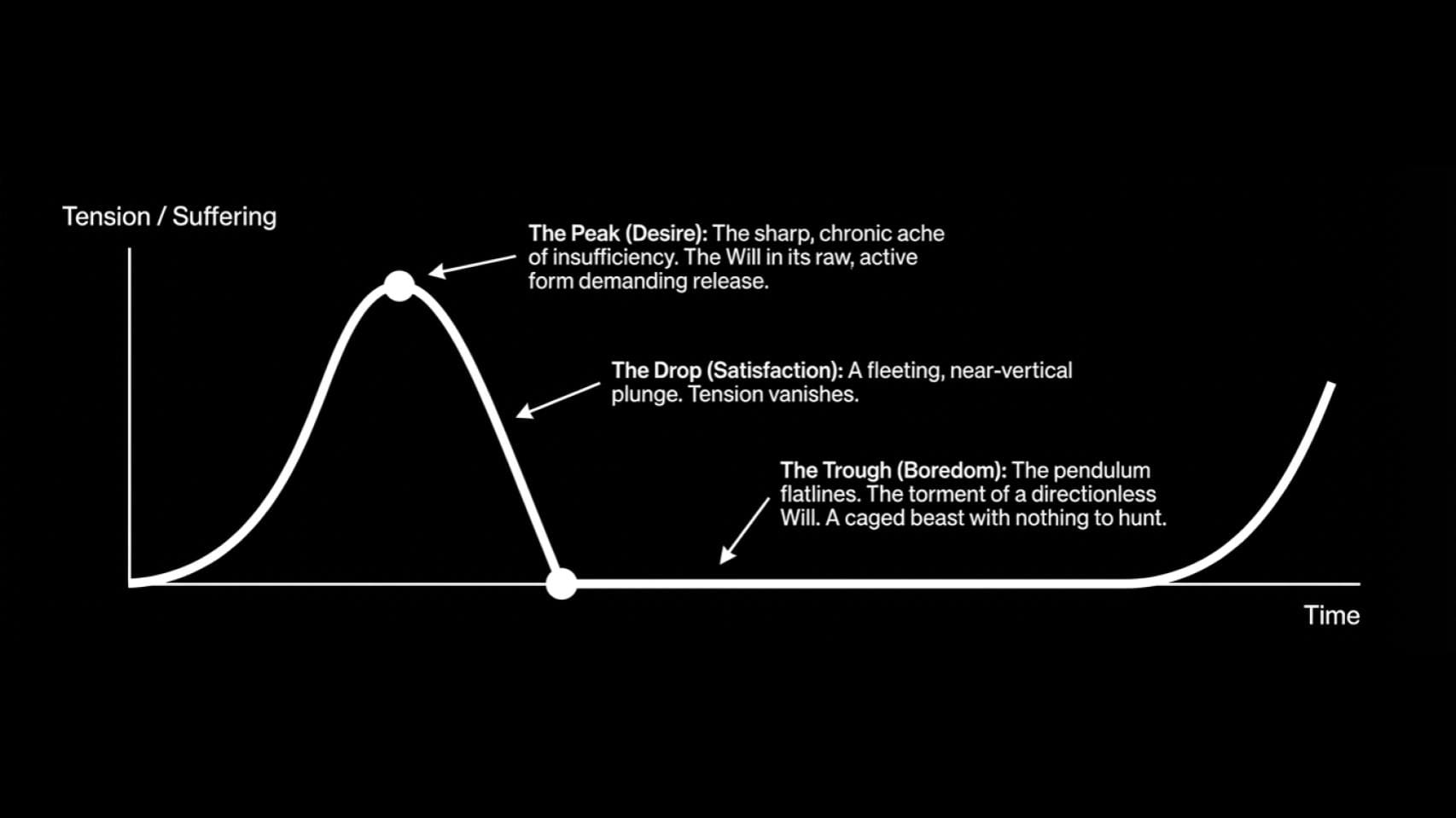
Born in 1788 into a wealthy patrician family, Schopenhauer was destined for a life of commerce. Instead, he chose philosophy, driven by a profound, almost pathological sensitivity to human suffering. His magnum opus, The World as Will and Representation (1818), posited a terrifying vision of reality. Beneath the world of appearances (Representation) lies the ultimate reality: the Will. This Will is not a benevolent, rational force, but a blind, surging, insatiable, and irrational drive for existence and reproduction. It is the source of all striving, all desire, and consequently, all suffering.
For decades, Schopenhauer’s masterpiece languished in obscurity. He lectured at the University of Berlin, deliberately scheduling his classes at the same time as the philosophical superstar G.W.F. Hegel, whom Schopenhauer despised as a charlatan. The result was humiliating: students flocked to Hegel, and Schopenhauer lectured to empty rooms.
He retreated into a life of bitter isolation in Frankfurt, living with a succession of poodles (all named Atman or Butz), estranged from his mother—the popular novelist Johanna Schopenhauer, whose lively salons he abhorred—and devoid of romantic companionship. It was in this cauldron of isolation, intellectual brilliance, and personal resentment that he penned Parerga and Paralipomena (1851), a collection of essays that finally brought him the fame he so desperately craved.
It is within this collection that we find the essays that trigger today's digital tripwires. Released from the dense, systematic rigor of his primary metaphysical works, Schopenhauer’s essays were accessible, aphoristic, and devastatingly cruel. He turned his penetrating, pessimistic gaze upon the society around him, dismantling the sacred cows of human progress, romantic love, and, most controversially, the nature and societal role of women.
This is a premium post. Subscribe to unlock the full video and the complete analysis.
Continue reading this briefing
You've reached the members-only portion of this 15 min read essay. Become a PhiloCrux member to finish it — and unlock the full archive of 25+ deep-dive masterclass and private audio briefing.
Already a member? Sign in