There is a specific, terrifying clarity that arrives at three in the morning when the rest of the world has surrendered to the oblivion of sleep, and you alone remain awake. The silence ceases to be merely the absence of noise and instead becomes a heavy, suffocating presence. It is in this precise, agonizing crucible of nocturnal isolation that all human illusions—career, legacy, romance, progress, and meaning—are violently stripped away. What remains is the naked, shivering architecture of existence itself.
For most of us, this is a fleeting terror, cured by the eventual rising of the sun and the mundane distractions of the morning commute. But for a twenty-two-year-old Romanian student in the early 1930s, this terror became a permanent state of being. Stripped of the biological mercy of sleep for months on end, he did not seek a medical cure; instead, he forged his agony into one of the most devastatingly beautiful and uncompromisingly pessimistic works of the twentieth century.
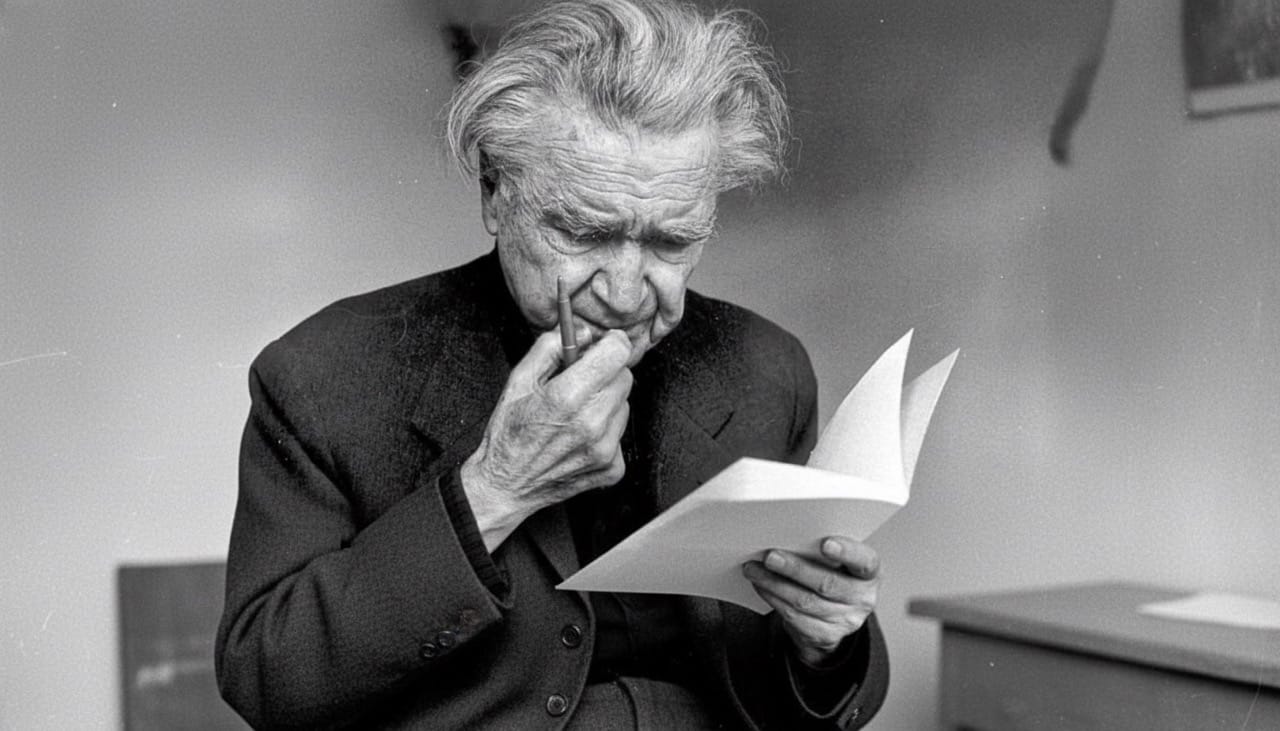
The young man was Emil Cioran, and the explosive manuscript he produced was On the Heights of Despair (Pe culmile disperării).
To read Cioran is to willingly step into an intellectual blast furnace. He is not a philosopher in the traditional, academic sense. He offers no systems, no comforting teleologies, and no ethical frameworks to guide your life. He is, rather, a prophet of absolute nothingness, a lyrical anti-philosopher who viewed human consciousness not as the pinnacle of evolutionary triumph, but as a tragic biological misstep—a terminal disease of matter.
Yet, why should we, the modern denizens of a hyper-optimized, endlessly positive twenty-first century, turn our gaze toward the ravings of a suicidal Romanian insomniac? Because within Cioran’s abyss lies a strange, paradoxical salvation. In an era suffocating under the weight of "toxic positivity" and the relentless demand for personal meaning, Cioran’s absolute negation offers a profound, almost euphoric liberation. To understand his despair is to unlock a terrifying but ultimate freedom.
The Transylvanian Crucible: Birth of an Anti-Philosopher
To fully grasp the magnitude of On the Heights of Despair, one must first understand the soil from which it sprang. Born in 1911 in Rășinari, a small village in the Transylvanian region of Romania, Cioran was the son of an Orthodox priest. His early childhood was, by his own admission, a period of paradisiacal bliss, spent roaming the Carpathian foothills. But this Edenic innocence was abruptly shattered when he was sent away to high school in Sibiu. The trauma of this separation from nature marked the beginning of his lifelong obsession with exile—not merely geographical exile, but ontological exile. To be born, for Cioran, was to be exiled from the peace of non-existence.
By the time he reached the University of Bucharest, Cioran was immersed in a vibrant, volatile intellectual milieu. He rubbed shoulders with future giants like the playwright Eugène Ionesco and the historian of religion Mircea Eliade. It was a generation desperate to shake off the provincialism of Romanian culture, flirting dangerously with radical politics, existentialism, and vitalism.
But Cioran’s true radicalization was not political; it was biological.
In his early twenties, Cioran was struck by a bout of severe, intractable insomnia. For years, he wandered the empty, lamplit streets of Sibiu like a ghost. Sleep is the great equalizer, the daily reset button that allows human beings to forget the tragedy of their existence and begin anew. Without it, time loses its rhythmic flow and transforms into a stagnant, suffocating swamp. Without the interruption of dreams, Cioran was forced to endure an unbroken, continuous waking nightmare. The protective barrier between the self and the void dissolved.
"I have lost the ability to sleep, and with it, the ability to believe in anything," he would later reflect.
Academic philosophy—the neat, rational systems of Kant, Hegel, and Descartes—suddenly appeared to him as a pathetic joke. How could a categorical imperative soothe a man who wanted to tear off his own skin? How could the dialectic of history matter to a mind screaming in the dark? Cioran abandoned the sterile halls of epistemology and turned to the bleeding, irrational precursors of existentialism: Schopenhauer, Nietzsche, Kierkegaard, and Dostoevsky.
On the Heights of Despair was written in a fever dream of exhaustion and suicidal ideation. He wrote it in Romanian, his mother tongue, in short, aphoristic bursts—lyrical explosions of grief, madness, and ecstasy. It was, as he famously stated, a book written out of necessity: "If I had not written it, I would have killed myself."
Continue reading this briefing
You've reached the members-only portion of this 16 min read essay. Become a PhiloCrux member to finish it — and unlock the full archive of 27+ deep-dive masterclass and private audio briefing.
Already a member? Sign in