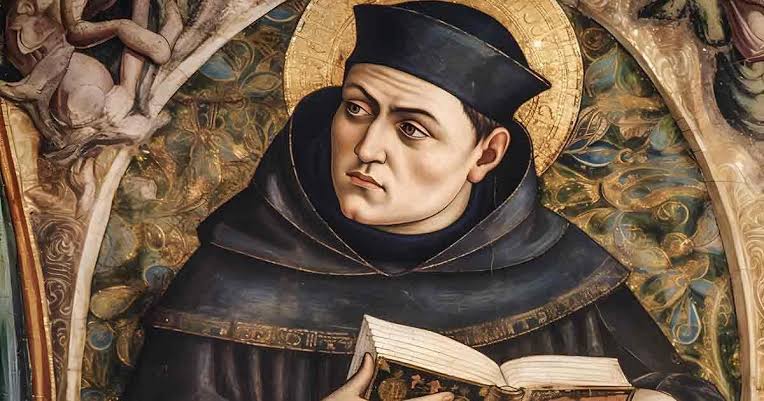
We are told by the modern consensus that we are the accidental byproducts of a celestial lottery, the results of cumulative errors in a genetic code that knows no destination. This is the doctrine of stochastic mutation—a world where meaning is a post-hoc hallucination projected onto a chaotic canvas. Yet, centuries before the first microscope peered into the cell, Thomas Aquinas articulated a vision of reality so structurally profound that it renders the modern obsession with 'randomness' a mere failure of observation. For Aquinas, the universe is not a series of lucky accidents; it is a meticulously ordered hierarchy where every creature moves with the certainty of an arrow toward its target.
The Fifth Way: The Governance of the World
To understand the Thomistic rejection of blind mutation, one must first encounter the Fifth Way, or the argument from the governance of things. Aquinas observed that natural bodies, which lack intelligence, act for an end. They do not merely exist; they behave with a startling consistency that achieves the best results. A sunflower does not 'decide' to track the sun, nor does the heart 'choose' the rhythm of its beat. They are directed. Aquinas argues that this direction cannot be the product of chance, for chance does not produce consistent perfection.
Now whatever lacks intelligence cannot move towards an end, unless it be directed by some being endowed with knowledge and intelligence; as the arrow is shot to its mark by the archer.
— Thomas Aquinas
In this framework, the modern concept of mutation—as a blind, undirected process—is an ontological impossibility. The universe is not a chaotic accident of drifting particles, but a choreographed symphony where every movement is directed toward a preordained horizon of perfection. What we call 'random' is often simply a lack of access to the primary mover’s intent.
The Great Chain of Being: A Ladder of Perfection
Central to Aquinas’s worldview is the 'Scala Naturae' or the Great Chain of Being. Unlike the modern evolutionary tree, which suggests a horizontal and aimless spreading of life, the Great Chain is a vertical ascent. It is a hierarchy of being that stretches from the lowliest minerals to the highest celestial intelligences. In this system, every being occupies a fixed ontological rank determined by its level of 'actuality'—its closeness to the pure existence of God.
- Inanimate Matter: Possesses existence but no life.
- Vegetative Souls: Possesses existence and life, but no consciousness.
- Sensitive Souls: Possesses life, movement, and perception.
- Rational Souls: The bridge between the material and the divine, capable of knowing the truth.
For Aquinas, the transition from one species to another via mutation would not be a 'progress' in the modern sense, but a rupture in the divine order. Each link in the chain is necessary to reflect the infinite variety of the Creator. To suggest that one link could 'accidentally' become another is to ignore the inherent purpose, or telos, that defines a creature's essence. A thing is what it is because it has a specific perfection to fulfill within the cosmic whole.
The Illusion of Stochastic Chaos
The contemporary mind clings to mutation because it offers a sense of liberation from design. If there is no purpose, there is no responsibility. However, Aquinas posits that 'chance' is a name we give to the intersection of two purposeful lines of causality that we do not yet understand. If a farmer finds buried treasure while plowing a field, the finding is 'chance' to him, but both the burying of the treasure and the plowing of the field were intentional acts. To suggest that biological complexity arises from blind error is to mistake the static of a radio for the transmission of the broadcast.
In the Thomistic view, the 'mutations' observed by modern science are not the drivers of life, but the secondary movements of a deeper, primary causality. Teleology—the study of ends and purposes—is the only lens through which the complexity of the eye or the precision of the cell becomes intelligible. Without an end-goal, there is no reason for any biological process to begin, let alone sustain itself through the rigors of existence.
Join "PhiloCrux" community.
Unlock high-density masterclasses and investigations into ideas surviving outside the algorithmic consensus. Support independent thought and get full access to our digital library.
Reclaiming the Teleological Vision
The transition from a teleological world to a stochastic one has not been without cost. It has left the modern subject stranded in a 'disenchanted' universe, where they are a stranger to their own nature. By returning to Aquinas, we find a world that is once again legible. We find that we are not the products of a cosmic mistake, but essential participants in a vast, ordered, and purposeful reality. We must recognize that the dignity of the human person is rooted not in our survival of a brutal lottery, but in our unique station at the apex of the material world.
The investigation into the 'why' of existence is far from over. In PhiloCrux, we go beyond the surface-level debates of 'evolution vs. creation' to explore the deep metaphysical structures that govern our reality. To understand the true nature of the soul and its place in the Great Chain, you must look deeper into the forbidden archives of Scholastic thought.