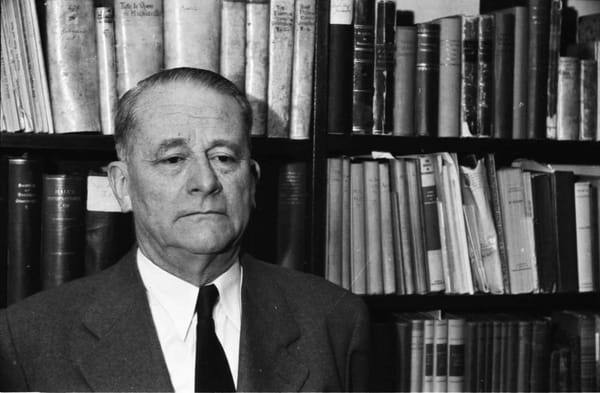
In the modern era, we are taught that civilization is a steady progression toward total safety, a long march from the chaotic wilderness into the illuminated, climate-controlled comfort of the digital city. We have been conditioned to believe that our true nature is found in the "gregarious and peaceful life," where conflict is an aberration and struggle is a design flaw. Yet, beneath the veneer of the urban consumer lies a deeper, older configuration of the human spirit. Maurice Bardèche, a thinker who remains intentionally obscured by the contemporary canon, posits a radical inversion of this narrative. He argues that the city is not our natural habitat but our cage, and that the "true man" only emerges when he is called back to his primal vocation: to protect, to tame, and to endure.
This investigation into "PhiloCrux" explores the uncomfortable thesis that human excellence is not a product of peace, but a byproduct of the military necessity that precedes it. We delve into the philosophy of the pioneer, the ethics of the crew in peril, and the forgotten truth that our most cherished civic virtues were forged in the heat of the forge, not the quiet of the library.
The Vocation of the Pioneer: The Animal Roots of Order
Bardèche’s analysis begins with a rejection of the Enlightenment's "social contract" in favor of a biological and historical realism. He suggests that the qualities we admire most—courage, discipline, and unyielding energy—are "properly military and, so to speak, animal." These are not abstract moral choices made by comfortable men; they are the functional requirements of the pioneer. The pioneer is the man who stands at the edge of the known world, facing the void. For him, "protection" is not a service purchased through taxation, but a physical exertion of the will.
- The Vitality of the Blood: Bardèche views the human animal as a creature designed for the taming of space. In this view, the "peaceful life" leads to a physiological and spiritual atrophy.
- Discipline as Survival: Discipline is not seen as an external imposition of authority, but as the internal hardening required to survive an environment that is indifferent to human life.
- The Protector’s Instinct: The foundational human unit is not the individual consumer, but the protector who stands between his kin and the encroaching dark.
The human being is a beast of prey. I shall say it again and again. All the moralizers who want to be more than that are only animals with their teeth drawn.
— Oswald Spengler
The Awakening of Danger: The Desert as Mirror
How do we rediscover this latent nature in an age of total convenience? Bardèche points to the "natural adversaries"—the storms, the catastrophes, and the deserts. These are the forces that strip away the "urban decadence" that accumulates like silt in a stagnant river. When a ship is caught in a gale or a group is lost in the wastes, the social hierarchies of the city vanish. What remains is a raw, functional reality where a man's worth is measured solely by his contribution to the group's survival. This "awakening of danger" forces a return to the "ethics of survival," where the spirit of sacrifice is no longer a rhetorical flourish but a life-or-death necessity.
- The Stripping of the Persona: Danger removes the masks of status and wealth, revealing the underlying character of the individual.
- The Crew in Peril: In moments of extreme crisis, the individual "I" is subsumed by the collective "We," creating a temporary, high-density community that the city can never replicate.
- The Functional Sacrifice: Sacrifice is reclaimed as a logical act of preservation for the "crew" rather than an abstract altruistic ideal.
The Luxury of the Warrior: The Origin of Civic Qualities
Perhaps the most provocative aspect of Bardèche’s thesis is his claim regarding the origin of "civic" virtues. Modern society takes qualities like politeness, honesty, and respect for granted, viewing them as the natural results of education. Bardèche argues the opposite: these are the "luxuries" of a military society that has succeeded in its mission. The code of the warrior—marked by "generosity" and "respect for the courageous adversary"—is the bedrock upon which all subsequent civilization is built. When the military hierarchy is established and the threat is tamed, these hard-won habits of the soul evolve into the softer virtues of the citizen.
- The Military Hierarchy as Foundation: Stable society is not born from a committee; it is born from a disciplined group that has secured a territory.
- The Code of the Adversary: The concept of "fair play" and respect for the enemy is a high-level military development that prevents the total descent into savagery.
- The Exactitude of the Word: Concepts like "fidelity" and "loyalty" are essential in "hours of uncertainty and abandonment," where a broken promise means death.
The man who is not prepared to fight for his life will never be a man, and the nation that is not prepared to fight for its existence will never be a nation.
— Ernst Jünger
The city is not the cradle of civilization but its mausoleum, for the virtues that sustain us are forged only in the presence of the predator and the storm.
Step into PhiloCrux.
Unlock high-density masterclasses and investigations into ideas surviving outside the algorithmic consensus. Support independent thought and get full access to our exclusive digital library.
Conclusion
To accept Bardèche’s thesis is to look at our modern world through a fractured lens. If our highest virtues are indeed "military" and "animal" in origin, then a society that seeks to eliminate all risk and struggle may inadvertently be eliminating the very qualities that make us human. We find ourselves in a strange paradox: the more "civilized" we become, the more we lose the "vocation to tame" that created civilization in the first place. This tension between the gregarious life of the city and the primal life of the protector is the central conflict of the modern soul.
This deep-dive is merely the threshold. In the full masterclass available to our subscribers, we explore the specific historical applications of these ideas, from the Spartan "generous life" to the modern psychological implications of living in a world without "natural adversaries." We examine the maps of the forbidden thinkers who saw the coming of the "hollow man" and sought a way back to the granite of human nature. Join us in the depths of "PhiloCrux" to unlock the full investigation.