The Ghost at the Banquet of Liberalism
We live in the ruins of a grand, centuries-old illusion. It is an illusion so pervasive, so deeply embedded in the architecture of the modern mind, that to question it feels akin to questioning the laws of gravity. This is the myth of the autonomous individual—the foundational premise of liberal modernity which posits that man is born free, independent, and pre-social, and that society is merely a mechanical artifice, a "contract" drafted by rational actors for their mutual convenience. From Thomas Hobbes to John Locke, and from Jean-Jacques Rousseau to John Rawls, the entire edifice of contemporary political architecture rests upon this single, unquestioned axiom.
But what if the "individual," as conceived by the Enlightenment, is an ontological impossibility? What if the social contract is not merely a historical fiction, but a philosophical absurdity?
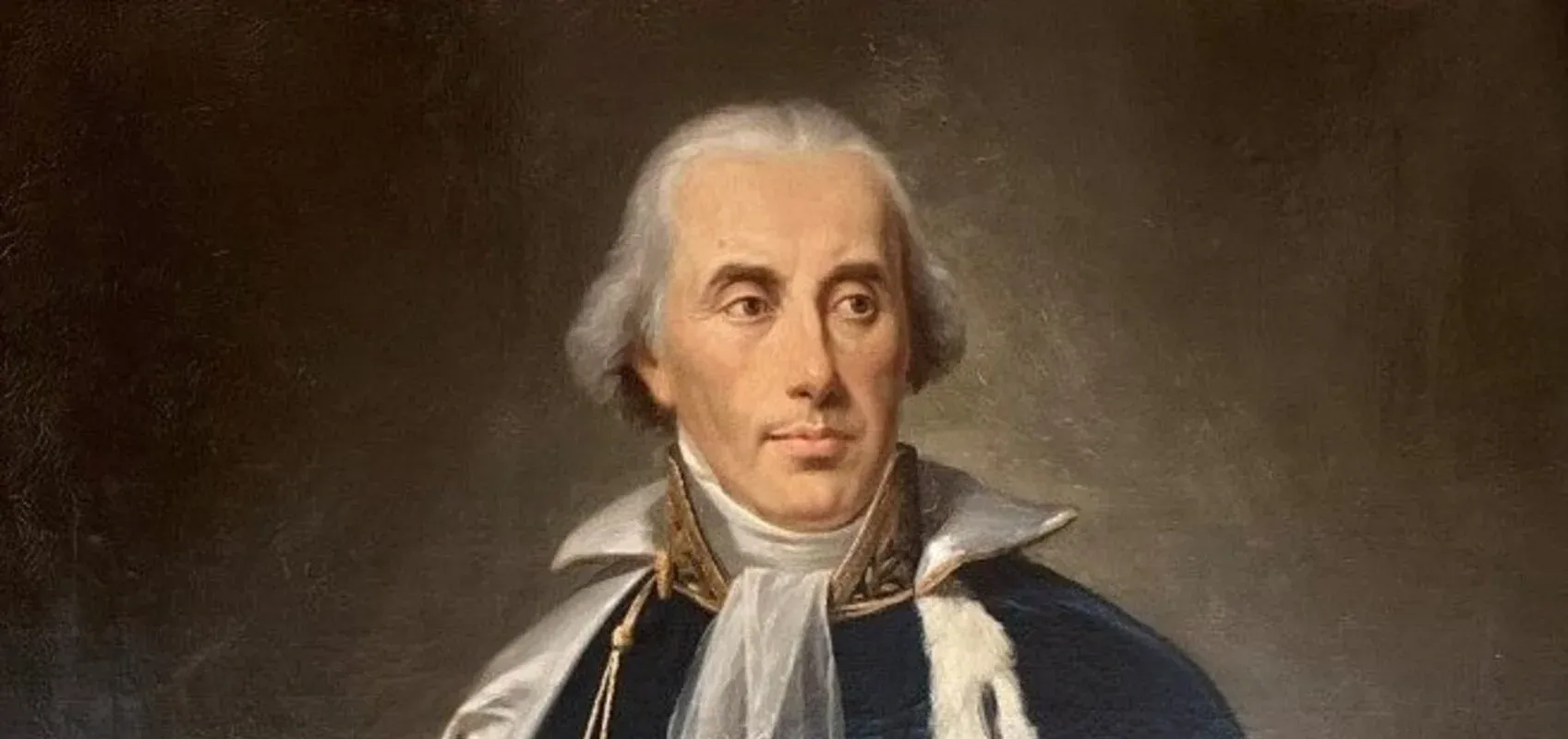
To answer these questions, we must resurrect a ghost. We must turn to a man whose ideas were considered so devastatingly dangerous to the revolutionary project that his magnum opus was hunted down and destroyed by the French Directory. That man is Louis Gabriel Ambroise, Vicomte de Bonald (1754–1840)—the cold, geometric logician of French Traditionalism and the forgotten architect of the counter-revolution.
While his contemporary, Joseph de Maistre, captivated Europe with fiery, mystical prose about blood and providence, Bonald operated with the chilling precision of a mathematician. In his suppressed 1796 masterpiece, Théorie du pouvoir politique et religieux (Theory of Political and Religious Power), Bonald did not merely criticize the French Revolution; he systematically dismantled the epistemological foundations of the Enlightenment. He insisted that society is a divinely ordained hierarchy rooted in the family and the throne, bound together by the unyielding laws of nature and God.
At the absolute center of Bonald’s system is the doctrine of "primitive revelation"—a theory of language and society that categorically annihilates the premise of liberal individualism. In this masterclass, we will explore why Bonald’s thought was systematically erased from the Western canon, and how his rigorous dialectic provides the ultimate antidote to the atomized, hyper-alienated wasteland of modern life.
Blood, Ink, and Exile: The Genesis of French Traditionalism
To understand the sheer radicalism of Bonald’s philosophy, one must first understand the crucible in which it was forged. By 1796, the French Revolution had mutated from a utopian dream of liberty and fraternity into a mechanized slaughterhouse. The guillotine had consumed the King, the Queen, the aristocracy, and eventually the revolutionaries themselves. The revolutionaries had attempted to reset time to Year One, to rename the months, to decimalize the clock, and to reconstruct society entirely on the basis of abstract, secular reason.
Bonald, a former musketeer and provincial nobleman, found himself in exile in Heidelberg, Germany. Stripped of his titles, his property, and his homeland, he lived in crushing poverty. Yet, in the freezing garrets of exile, he did not write a lamentation; he wrote a totalizing theory of human existence.
The Enlightenment philosophes had argued that man created society. Rousseau famously declared that man is born free but is everywhere in chains, suggesting that the structures of family, church, and state were artificial impositions. Bonald looked at the bloodshed in Paris and realized that the Terror was not an aberration of Enlightenment philosophy, but its inevitable logical conclusion. If society is merely a contract made by men, it can be unmade by men. If authority derives only from the shifting will of the majority, then power is inherently unstable, and the only way to enforce the "general will" is through the blade of the guillotine.
When Bonald published Theory of Political and Religious Power in Constance, he smuggled copies into France. The Directory, recognizing the lethal threat this book posed to their legitimacy, ordered the police to seize and destroy almost every single copy. Bonald was forced to rewrite his ideas in subsequent, slightly diluted works. But the original Theory remains one of the most astonishing works of political philosophy ever penned—a book that attempts to prove the necessity of absolute monarchy and divine revelation using the strict, deductive logic of a geometric proof.
Continue reading this briefing
You've reached the members-only portion of this 16 min read essay. Become a PhiloCrux member to finish it — and unlock the full archive of 25+ deep-dive masterclass and private audio briefing.
Already a member? Sign in