Humanity suffers from a profound terrestrial bias. Because we are bipedal mammals bound to the soil, we instinctively view the world as a collection of landmasses separated by water. We draw our maps with the continents at the center, vividly colored, while the oceans are rendered as empty blue voids—mere negative space. Yet, to look at the globe through the eyes of a grand strategist is to invert this perspective entirely. The Earth is a single, continuous, world-spanning ocean, occasionally interrupted by islands. Some of these islands are small, like Britain or Japan; others are massive, like Eurasia or the Americas. But the fundamental truth of geopolitics remains: whoever commands the continuous blue fluid commands the globe.
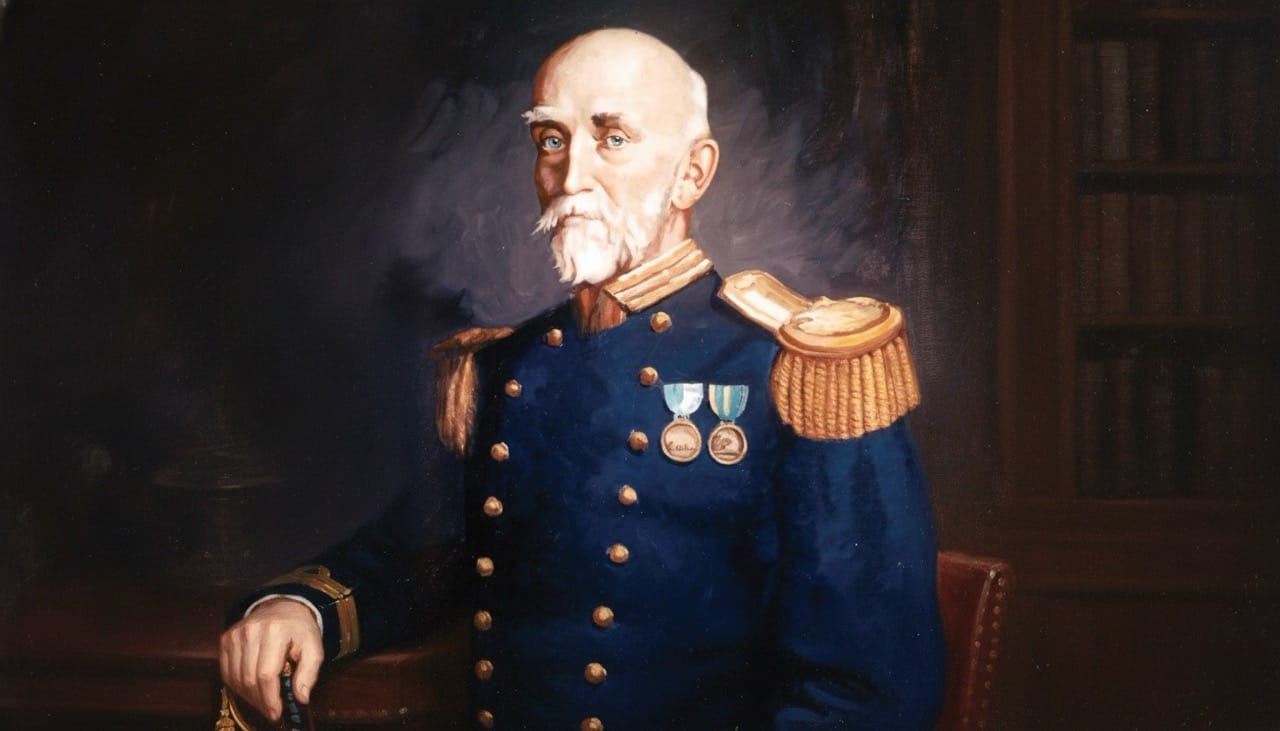
This counterintuitive revelation is the bedrock of modern geopolitical thought, and it was articulated with world-shattering clarity in 1890 by an unassuming, sea-sick American naval officer named Alfred Thayer Mahan. In his magnum opus, The Influence of Sea Power Upon History, 1660–1783, Mahan shattered the conventional wisdom that empires were built by marching armies across continents. Instead, he proved that the true engine of hegemony was the unglamorous, relentless, and absolute control of the sea lanes.
For the modern intellectual, investor, or strategist, understanding Mahan is not a mere exercise in historical trivia. We are currently living through a dramatic renaissance of great power competition, where the flashpoints are not land borders, but maritime chokepoints: the Strait of Malacca, the South China Sea, the Bab el-Mandeb, and the Taiwan Strait. The United States, the ultimate inheritor of the Anglo-American maritime tradition, now faces an unprecedented naval buildup by a rising continental power. To understand the 21st century, we must resurrect the raw, 19th-century naval strategy that built the modern world order.
The Prophet of the Pacific and the Twilight of Wood and Sail
To appreciate the seismic impact of Mahan’s theories, one must understand the era into which they were born. The late 19th century was a period of dizzying technological and political transformation. The Industrial Revolution had rendered the romantic era of wind, wood, and sail obsolete. Navies were transitioning to coal-fired steam engines, ironclad hulls, and rifled artillery. Yet, despite these technological leaps, the strategic doctrine governing how these new leviathans should be used was entirely absent.
Following the American Civil War, the United States Navy had fallen into a state of embarrassing disrepair. As America looked inward, consumed by Manifest Destiny and the settlement of the western frontier, its navy rusted at anchor. By the 1880s, the U.S. fleet was smaller than that of Chile.
Enter Alfred Thayer Mahan. Ironically, Mahan was not a swashbuckling hero of the high seas. He was an introverted, scholarly man who actively disliked serving on ships and lived in constant fear of ocean storms. In 1885, he was appointed to lecture on naval history and tactics at the newly established Naval War College in Newport, Rhode Island. Tasked with creating a curriculum out of thin air, Mahan sequestered himself in the library, pouring over the histories of the British, French, and Dutch empires.
What he discovered was a recurring historical algorithm. Why did the British Empire, a damp, relatively small island nation on the periphery of Europe, manage to defeat the massive continental armies of France and Spain time and time again? Mahan’s answer was unequivocal: the Royal Navy. Britain’s wealth, derived from global maritime commerce, funded its wars, while its fleet blockaded European rivals, starving them of resources.
Mastercalss Materials
When Mahan published his lectures as a book in 1890, the reaction was explosive. It was read with religious fervor by Theodore Roosevelt, who would use it as the blueprint to build the "Great White Fleet" and construct the Panama Canal. In Europe, Kaiser Wilhelm II of Germany ordered a translated copy placed in the wardroom of every German naval vessel, sparking the Anglo-German naval arms race that would precipitate World War I. Across the globe, the Japanese Imperial Navy adopted Mahanian doctrine wholesale, culminating in their stunning annihilation of the Russian fleet at the Battle of Tsushima in 1905.
Mahan did not just write a history book; he wrote the source code for 20th-century imperialism. He transformed the ocean from a chaotic wilderness into a chessboard.
Continue reading this briefing
You've reached the members-only portion of this 17 min read essay. Become a PhiloCrux member to finish it — and unlock the full archive of 25+ deep-dive masterclass and private audio briefing.
Already a member? Sign in