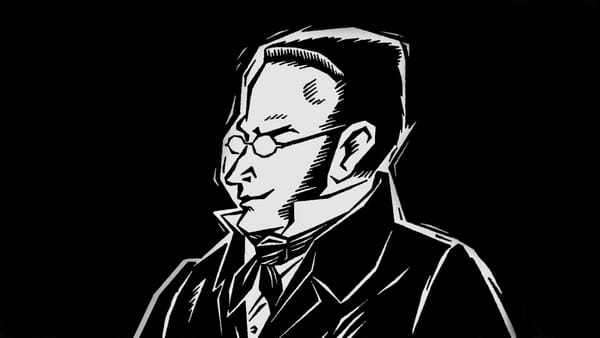
To the modern mind, money is a neutral utility, a lubricant for the gears of commerce. But to Ezra Pound, the poet-prophet whose life was dismantled for his relentless pursuit of economic truth, money was never neutral. It was a weapon of mass extraction, a tool of civilizational capture that he termed "Usura." Pound saw the banking system not as a facilitator of trade, but as a parasitic layer that suffocates the creative output of humanity.
With usura hath no man a house of good stone / each block cut smooth and well fitting / that design might cover their face.
— Ezra Pound
Pound’s critique was a forensic analysis of how the financial class seizes the productive energy of a nation. In PhiloCrux today, we reconstruct Pound’s vision of the five-step descent from organic sovereignty to the digital panopticon. This is the timeline of the ultimate swindle.
1. The Seizure of the Physical Anchor
The domination began by tying the concept of value to a scarce, physical commodity—primarily gold. While proponents argue this provides stability, Pound viewed the gold standard as the first stage of the trap. The banker is not a merchant of capital, but a weaver of illusions who sells the privilege of access to one's own labor. By controlling the physical supply of the anchor, the banking class ensured that no expansion of human productivity could occur without their explicit permission and a corresponding debt entry. The "scarcity" was manufactured to justify the banker's fee.
2. The Alchemical Multiplication
Once the anchor was established, the banks transitioned to fractional reserve lending. This is the moment where the banker becomes a creator of "nothingness." By lending out more paper receipts than they held in physical gold, they effectively minted currency from the thin air of future obligations. Pound saw this as a betrayal of the community; it allowed a private priesthood to tax the energy of the people by manipulating the volume of the medium of exchange. The bank creates the debt, but the people must perform the work to pay the interest.
3. The Divorce from Nature: The Fiat Era
The third step was the total decoupling of currency from any physical reality. In the fiat era, money became a pure abstraction—a political decree. Pound understood that when money is no longer anchored to "the work of the hands" or even a physical stone, it becomes a tool for total social engineering. Inflation is not a bug of this system; it is a mechanism to ensure that the populace is forced to run faster just to stand still, while the value of their labor is siphoned into the central ledger through the erosion of purchasing power.
4. The Technocratic Enclosure
As we enter the late stages of domination, the banking elite move to eliminate the last vestiges of private, peer-to-peer exchange. This is the enclosure of the financial commons. Through the digitization of transactions, the "algorithmic consensus" begins to monitor and gatekeep all economic movement. Pound’s warning that usury destroys the "craftsman’s eye" manifests here as the destruction of the independent producer who cannot survive without the blessing of the centralized financial apparatus. Cash, the final anonymous medium, is systematically targeted for extinction.
Join "PhiloCrux" community.
Unlock high-density masterclasses and investigations into ideas surviving outside the algorithmic consensus. Support independent thought and get full access to our digital library.
5. The Final Ledger: CBDCs
The historical progression culminates in Central Bank Digital Currencies (CBDCs). This is the endgame Pound feared but could only partially visualize. This is not just digital money; it is programmable control. To understand the CBDC is to understand that the final frontier of colonization is not a territory, but the very ledger of your existence. Under this regime, the banker has the power to reward compliance and delete dissent with a single keystroke, completing the transformation of the citizen into a permanent debtor within a closed-loop system of state-banking surveillance.
The progression from gold to digits is not an evolution of efficiency, but a narrowing of the cage. Pound’s analysis remains the definitive indictment of this process, reminding us that when the medium of exchange is owned by a few, the soul of the culture is sold to the highest bidder. This is only the surface of the investigation. Inside PhiloCrux, we dismantle the mechanisms of the ledger further. Are you ready to see the code behind the curtain?